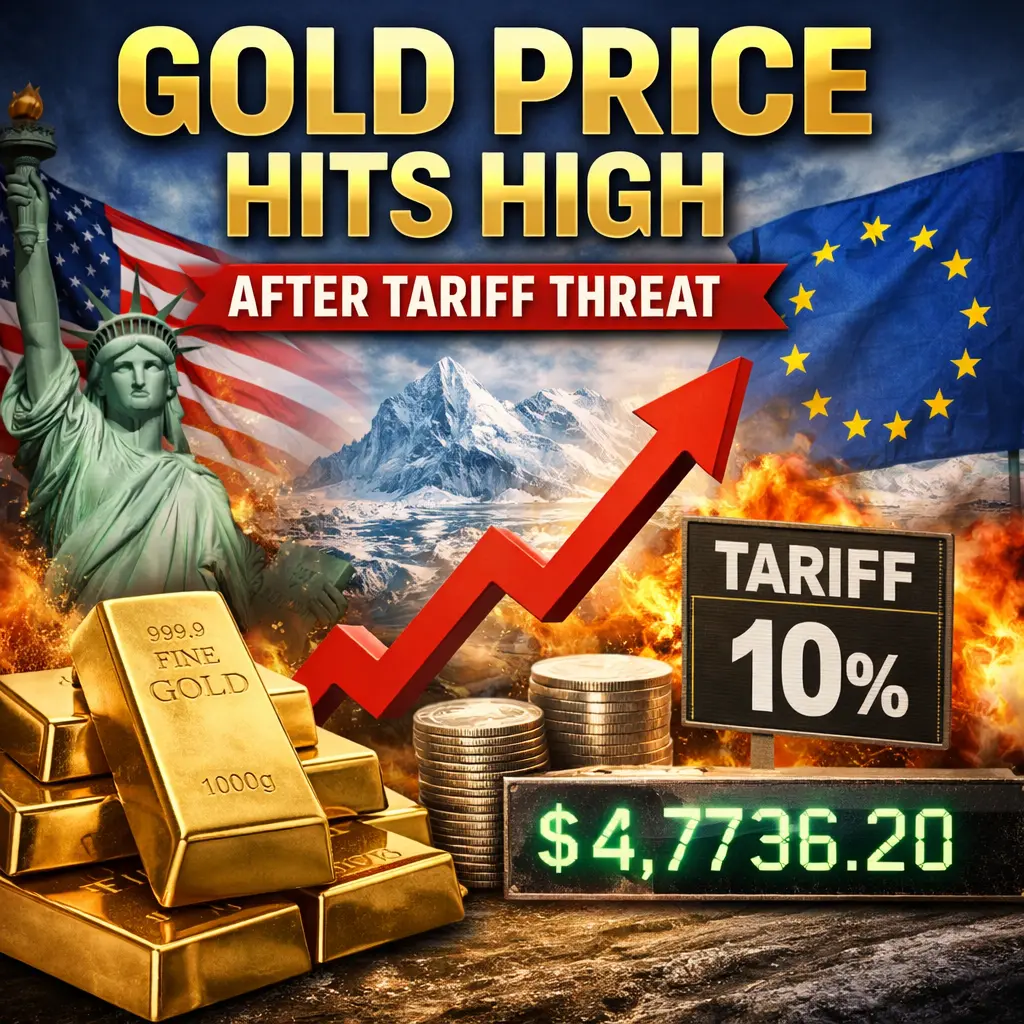
In a move that has stunned global financial markets, the gold price hits high marks once again, soaring past the psychological barrier of $4,700 per ounce this January 2026.
As of today, January 21, spot gold is trading near $4,736, representing a staggering 78% increase over the last 12 months.
But what exactly is fueling this golden run, and is the $5,000 threshold next? Let’s dive into the geopolitical and economic forces driving this historic surge.
The Greenland Factor
The primary catalyst for this week’s price explosion is a sharp escalation in trade tensions between the United States and Europe. The standoff centers on President Donald Trump’s renewed ambitions regarding Greenland.
Following a refusal by Denmark to negotiate the island’s status, the U.S. administration announced plans to impose 10% tariffs (potentially rising to 25% by Jun) on eight major European nations, including France, Germany, and the UK.
As global investors brace for a transatlantic trade war, they are fleeing traditional equities in favor of safe-haven assets. In times of extreme political unpredictability, gold remains the ultimate insurance policy.
When transactional foreign policy bypasses multilateral frameworks, it erodes the credibility of the U.S. dollar, incentivizing a massive rotation into bullion.
Economic Headwinds
While the headlines are dominated by Greenland, structural economic concerns are providing the foundation for this rally:
-
Sovereign Debt Stress: High fiscal deficits in the U.S., Europe, and Japan have revived fears of long-term inflation. Investors are increasingly viewing gold as a debasement hedge against currencies losing their purchasing power.
-
A Weakening Dollar: The U.S. dollar recently saw its largest daily drop in over a month. Since gold is denominated in dollars, a weaker greenback makes the metal cheaper for international buyers, further boosting demand.
-
Central Bank Accumulation: Emerging market central banks are continuing a multi-year trend of diversifying away from the dollar. According to J.P. Morgan Global Research, central bank buying is projected to remain elevated throughout 2026, providing a solid floor for prices.
Is $5,000 Per Ounce the Next Stop?
Analysts at major financial institutions, including Citigroup, Goldman Sachs, and UBS, are already eyeing the $5,000 mark.
With the Relative Strength Index (RSI) currently hovering near 70, the market is technically overbought, but the momentum remains undeniably bullish.
UBS recently predicted that gold could reach $5,000 by the end of Q1 2026, provided the current resource nationalism trend continues.
However, experts warn of crowded trade risks, suggesting that while the long-term outlook is constructive, short-term volatility is likely as the market digests these massive gains.
The Silver Lining
Gold isn’t the only metal making waves. In its shadow, silver has tripled in value over the last year, hitting an all-time peak of $95.50. This broader rally in precious metals suggests a systemic shift in investor sentiment toward hard assets.
Summary for Investors
As the gold price hits high after high, the narrative has shifted from “if” to “how much further.” For the average investor, the current climate serves as a reminder of gold’s role as a stabilizer.
Whether it’s a trade war over Arctic territory or the erosion of central bank independence, gold thrives on the very uncertainty that rattles other markets.
Key Takeaways for Today:
-
Price Peak: Gold is trading at a record level of $4,736.20. In Malaysia, Public Gold prices are RM672 per gram and RM1,587 for 100 grams of silver.
-
Trigger: U.S.–EU tariff threats regarding Greenland control.
-
Support: Massive central bank demand and a weakening U.S. dollar.
-
Outlook: Targets are now shifting toward the $5,000 psychological resistance level.
Disclaimer: This article is for informational purposes only and does not constitute financial advice. Always consult with a professional before making investment decisions.